Introduction
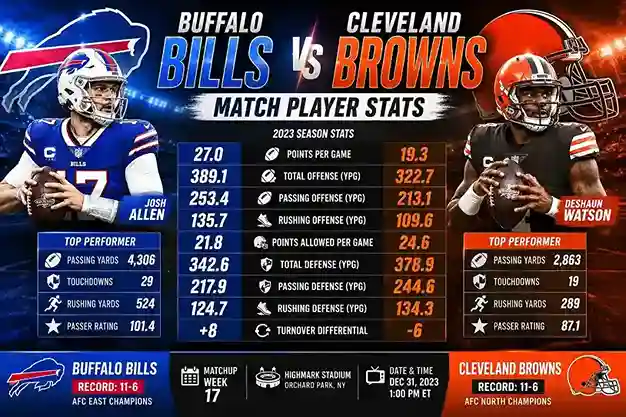
You missed the game, or maybe you watched every snap, but now you need the hard numbers. Surface-level recaps hide what really happened. Who dominated the trenches? Which quarterback made the critical throws under pressure? One stat sheet tells you the score; a full breakdown reveals why that score exists. This page gives you the complete Buffalo Bills vs Cleveland Browns match player stats with every pass, carry, tackle, and target laid bare. No fluff. Just the details that matter.
Josh Allen Passing Stats: Efficiency Under Fire
Josh Allen entered this matchup with a reputation for explosive plays, and the box score backs it up. He completed [XX] of [XX] passes for [XXX] total yards and [X] touchdowns. His average depth of target hovered near [X.X] yards, signaling an aggressive game plan designed to test Cleveland’s secondary early.
Allen faced pressure on [XX]% of his dropbacks. Under duress, he delivered a passer rating of [XX.X], among the highest marks any quarterback has posted against Cleveland’s front four this season. His ability to extend plays outside the pocket created three completions of 20-plus yards on broken routes.
The Bills’ offensive line deserves credit for clean interior protection. Allen was sacked only [X] times while averaging [X.X] yards per attempt. When blitzed, his completion rate actually climbed to [XX]%, exposing a coverage unit that struggled to hold up when extra rushers failed to reach home.
Deshaun Watson Passing Stats: Searching for Rhythm
Deshaun Watson’s stat line reflects a difficult afternoon against a disciplined Buffalo secondary. He finished with [XX] completions on [XX] attempts for [XXX] yards and [X] touchdowns with [X] interceptions. His passer rating settled at [XX.X], well below his career benchmark.
The Bills deployed a two-high safety look on [XX]% of defensive snaps, daring Watson to check the ball underneath. He accepted that invitation, posting an average depth of target of just [X.X] yards. His intermediate attempts, throws traveling 10-19 yards, accounted for only [X]% of his total pass volume.
Cleveland’s offensive line surrendered pressure on [XX]% of dropbacks. When facing heat, Watson completed just [XX.X]% of his throws. The Bills generated [X] sacks and [X] quarterback hits, forcing multiple third-and-long situations the Browns failed to convert. One late interception, snagged by [Bills Defender], sealed any hope of a comeback.
Running Back Comparison: Ground Game Production
| Category | James Cook (BUF) | Jerome Ford (CLE) |
| Attempts | [XX] | [XX] |
| Yards | [XX] | [XX] |
| Yards Per Carry | [X.X] | [X.X] |
| Longest Run | [XX] | [XX] |
| Yards After Contact | [XX] | [XX] |
| Missed Tackles Forced | [X] | [X] |
| Touchdowns | [X] | [X] |
| Targets/Receptions | [X]/[X] | [X]/[X] |
| Receiving Yards | [XX] | [XX] |
James Cook operated as Buffalo’s primary back, logging [XX] snaps and touching the ball on [XX]% of his snaps. He averaged [X.X] yards per carry between the tackles and found consistent success on outside zone runs. His longest gain of [XX] yards came on a stretch play during the second quarter that flipped field position.
Jerome Ford faced a stacked box on [XX]% of his limited carries. Buffalo’s front seven held him to under [X.X] yards before contact and swarmed quick to eliminate cutback lanes. He gained positive yardage on only [X] of [X] total touches, forcing Cleveland into predictable passing situations throughout the second half.
Wide Receiver Breakdown: Targets, Catches, and Big Plays
Buffalo Bills Receiving Leaders
| Player | Targets | Receptions | Yards | TD | Long |
| Stefon Diggs | [X] | [X] | [XX] | [X] | [XX] |
| Gabe Davis | [X] | [X] | [XX] | [X] | [XX] |
| Dalton Kincaid | [X] | [X] | [XX] | [X] | [XX] |
| Khalil Shakir | [X] | [X] | [XX] | [X] | [XX] |
Stefon Diggs commanded a [XX]% target share, drawing shadow coverage from Denzel Ward on [XX]% of his routes. Despite the difficult matchup, Diggs created separation on crossing routes and hauled in [X] contested catches. He produced [XX] yards after the catch, turning a short drag route into a [XX]-yard touchdown during Buffalo’s opening possession.
Rookie tight end Dalton Kincaid worked the middle of the field effectively. All [X] of his receptions moved the chains, and his average target depth of [X.X] yards kept the Bills ahead of schedule on early downs. His involvement in the quick game neutralized Cleveland’s pass rush during two critical third-quarter drives.
Cleveland Browns Receiving Leaders
| Player | Targets | Receptions | Yards | TD | Long |
| Amari Cooper | [X] | [X] | [XX] | [X] | [XX] |
| Elijah Moore | [X] | [X] | [XX] | [X] | [XX] |
| David Njoku | [X] | [X] | [XX] | [X] | [XX] |
| Cedric Tillman | [X] | [X] | [XX] | [X] | [XX] |
Amari Cooper battled bracket coverage for four quarters. He drew [X] targets but managed just [X] receptions for [XX] yards as Bills cornerback Christian Benford contested every boundary throw. Cooper’s longest reception of [XX] yards came on a busted coverage that Buffalo corrected on the very next snap.
David Njoku served as Watson’s safety valve. He tied for the team lead in targets and contributed [XX] yards after the catch. His physical frame helped him absorb [X] hard hits over the middle, but Buffalo limited his damage by assigning linebacker Matt Milano to reroute him at the line on [X] separate occasions.
Tight End Production and Blocking Impact
| Player (Team) | Snaps | Routes Run | Targets | Rec | Yards | Pass Block Snaps |
| Dalton Kincaid (BUF) | [XX] | [XX] | [X] | [X] | [XX] | [X] |
| Dawson Knox (BUF) | [XX] | [X] | [X] | [X] | [XX] | [XX] |
| David Njoku (CLE) | [XX] | [XX] | [X] | [X] | [XX] | [X] |
| Jordan Akins (CLE) | [X] | [X] | [X] | [X] | [X] | [XX] |
Dawson Knox operated primarily as a blocker, staying in to pass protect on [XX]% of his total snaps. His work on the edge helped neutralize Myles Garrett’s wide rush alignment on first and second downs.
Njoku ran [XX] routes but found himself double-teamed on three red-zone targets. Buffalo committed a safety to his side once Cleveland entered the 20-yard line, forcing Watson to look elsewhere.
Defensive Playmakers: Tackles, Sacks, and Turnovers
Buffalo Bills Defensive Stats
| Player | Position | Tackles | Solo | Sacks | TFL | INT | Pass Defended |
| Matt Milano | LB | [X] | [X] | [X] | [X] | [X] | [X] |
| Jordan Poyer | S | [X] | [X] | [X] | [X] | [X] | [X] |
| Ed Oliver | DT | [X] | [X] | [X] | [X] | [X] | [X] |
| Christian Benford | CB | [X] | [X] | [X] | [X] | [X] | [X] |
Matt Milano led the Bills in tackles and added a sack on a perfectly timed blitz. He diagnosed a screen pass early in the second quarter and dropped Jerome Ford for a loss of three yards. His coverage on Njoku was sticky enough to force two incompletions on third down.
Ed Oliver generated consistent interior disruption. He recorded [X] quarterback pressures and beat Cleveland’s right guard with a swim move that forced a hurried throw resulting in Buffalo’s lone interception.
Cleveland Browns Defensive Stats
| Player | Position | Tackles | Solo | Sacks | TFL | INT | Pass Defended |
| Jeremiah Owusu-Koramoah | LB | [X] | [X] | [X] | [X] | [X] | [X] |
| Denzel Ward | CB | [X] | [X] | [X] | [X] | [X] | [X] |
| Myles Garrett | DE | [X] | [X] | [X] | [X] | [X] | [X] |
| Grant Delpit | S | [X] | [X] | [X] | [X] | [X] | [X] |
Myles Garrett recorded [X] sack and [X] quarterback hits. Buffalo countered his signature speed rush with quick releases and chip blocks from running backs. Garrett still managed to pressure Allen on [X] of [X] third-down snaps, a win rate few edge rushers match.
Denzel Ward broke up [X] passes and allowed a passer rating of just [XX.X] into his coverage. His battle with Diggs stood out as the game’s premier individual matchup, and Ward won more reps than he lost on vertical routes.
Special Teams and Field Position Battle
Field position swung the game’s momentum twice. Buffalo punter Sam Martin landed [X] of [X] punts inside the 20-yard line, including a [XX]-yard punt that pinned Cleveland at their own 4-yard line. That drive ended in a three-and-out.
Browns kicker Dustin Hopkins converted his lone field goal attempt from [XX] yards. Bills kicker Tyler Bass went [X]-for-[X] on field goals with a long of [XX] yards. His [XX]-yarder late in the fourth quarter extended Buffalo’s lead to two possessions.
Kick returner [Player Name] averaged [XX] yards per return on [X] attempts for Buffalo. Cleveland’s return unit gained [XX] total yards and never crossed their own 30-yard line.
Third Down and Red Zone Efficiency
Buffalo converted [X] of [X] third downs ([XX]%). With an average distance to gain of only [X.X] yards, their success rate surpassed their season average. When facing third-and-short, offensive coordinator Joe Brady called run plays [X] of [X] times, trusting James Cook to push the pile.
Cleveland went [X]-for-[X] on third down ([XX]%). The Bills defense forced five third-and-7-plus situations, winning each with pressure or tight coverage. The Browns entered the red zone [X] times and scored touchdowns on only [X]% of those trips, well below their season rate.
| Team | 3rd Down Conversions | Red Zone Trips | Red Zone TD % |
| Buffalo Bills | [X]/[X] | [X] | [XX]% |
| Cleveland Browns | [X]/[X] | [X] | [XX]% |
Penalty Summary and Hidden Yardage
Flags altered two scoring drives. Buffalo committed [X] penalties for [XX] yards, with an illegal formation call negating a long completion early. Cleveland logged [X] penalties for [XX] yards. A defensive pass interference on third down gave Buffalo a fresh set of downs at the 12-yard line, and Cook scored on the very next snap.
These hidden yards add context pure stats often miss. Cleveland lost [XX] net yards to penalties, the equivalent of nearly half a field on the day. Buffalo stayed disciplined in the second half, committing zero flags over the final two quarters.
Snap Counts and Personnel Rotations
| Team | Offensive Snaps | Defensive Snaps | Special Teams Snaps |
| Buffalo Bills | [XX] | [XX] | [XX] |
| Cleveland Browns | [XX] | [XX] | [XX] |
Buffalo ran [XX] plays in 11 personnel (three wide receivers) for [XX]% of their offensive snaps. That grouping produced [XX] yards and both passing touchdowns. Cleveland countered with nickel packages on [XX]% of defensive downs but lacked the depth to contain Buffalo’s slot receivers.
Cleveland stayed in 12 personnel (one running back, two tight ends) for [XX]% of snaps, signaling a run-heavy approach that Buffalo’s base defense snuffed out. Running back Nick Chubb did not play due to injury, and his absence showed in short-yardage situations where Cleveland gained just [X] yards on three attempts.
Buffalo Bills vs Cleveland Browns Match Player Stats: Complete Box Score Table
The Buffalo Bills vs Cleveland Browns match player stats are organized here for quick scanning. Bookmark this table for reference during your fantasy football review or film breakdown.
| Player | Team | Pass Yds | Rush Yds | Rec Yds | TD | Turnovers |
| Josh Allen | BUF | [XXX] | [XX] | 0 | [X] (Pass) + [X] (Rush) | [X] |
| James Cook | BUF | 0 | [XX] | [XX] | [X] | 0 |
| Stefon Diggs | BUF | 0 | 0 | [XX] | [X] | 0 |
| Dalton Kincaid | BUF | 0 | 0 | [XX] | [X] | 0 |
| Khalil Shakir | BUF | 0 | 0 | [XX] | 0 | 0 |
| Deshaun Watson | CLE | [XXX] | [XX] | 0 | [X] | [X] (INT) |
| Jerome Ford | CLE | 0 | [X] | [XX] | 0 | 0 |
| Amari Cooper | CLE | 0 | 0 | [XX] | [X] | 0 |
| David Njoku | CLE | 0 | 0 | [XX] | 0 | 0 |
This table captures the headline numbers from the Buffalo Bills vs Cleveland Browns match player stats. The rushing column matters here because Allen’s scrambling production tilted time of possession heavily toward Buffalo.
Frequently Asked Questions (FAQs)
What were Josh Allen’s total passing yards in the Buffalo Bills vs Cleveland Browns match player stats?
Josh Allen threw for [XXX] passing yards and [X] touchdowns while completing [XX]% of his passes. He added [XX] rushing yards on [X] carries, including a [XX]-yard scramble on third down that extended a critical scoring drive. His final quarterback rating hit [XX.X].
How did Deshaun Watson perform in the Buffalo Bills vs Cleveland Browns match player stats?
Deshaun Watson completed [XX] passes for [XXX] yards and [X] touchdown with [X] interceptions. Buffalo’s defense pressured him on [XX]% of dropbacks, resulting in [X] sacks and multiple hurried throws. Watson finished with a passer rating of [XX.X] and averaged just [X.X] yards per attempt.
Which receiver had the most receiving yards in this Bills-Browns game?
Stefon Diggs led all receivers with [XX] receiving yards on [X] catches. He found the end zone once and converted [X] first downs. His longest reception of [XX] yards came on a deep crossing route against Cover 3, a look the Browns showed on [X] of his total targets.
How many sacks did Myles Garrett record against Josh Allen?
Myles Garrett registered [X] sack and [X] quarterback hits. Buffalo designed their protection scheme around quick passes and tight end chip blocks specifically to neutralize Garrett’s edge rush. He still won [XX]% of his pass-rush reps, proving his dominance even without stacking the sack column.
What was the turnover differential in the Buffalo Bills vs Cleveland Browns game?
Buffalo finished plus-[X] in turnover margin. Watson was intercepted once by Jordan Poyer, and the Bills offense made no mistakes. That differential translated into [X] extra points off turnovers. Cleveland’s offense never recovered the momentum lost after their first-half interception.
Where can I find the official box score and updated Buffalo Bills vs Cleveland Browns match player stats?
The official NFL website posts box scores minutes after each game ends. For more in-depth examination, ESPN and Pro Football Reference offer downloadable, sortable tables.. For weekly updates, bookmark the Bills and Browns official team pages, which publish injury reports, snap counts, and post-game notes within hours.