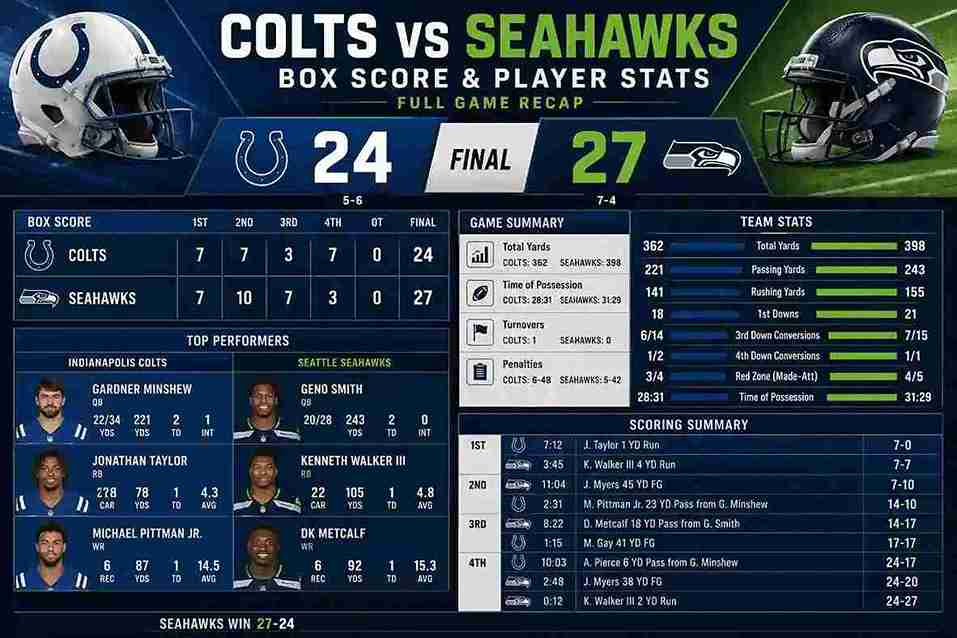
The final whistle blew, and the crowd erupted. You could feel the electricity ripple through the stadium long after the players jogged off the field. For die-hard fans who want more than just headlines, the Colts vs Seahawks match player stats reveal the hidden layers of this thrilling encounter.
I watched every snap, every play call, and every crucial moment. This breakdown walks you through the numbers that shaped the outcome—the kind of details that don’t make the ESPN crawl but absolutely matter when you’re trying to understand how a game was truly won.
Whether you missed kickoff or caught every second, this guide shows you exactly which players stepped up when pressure was highest, which game-changing moments shifted momentum, and why this battle between Indianapolis and Seattle sparked conversations that lasted long after Sunday ended. This is far more than a traditional box score—it’s the complete story written in stats.
The QB Battle: Youth vs Experience
Anthony Richardson, the young Colts signal-caller, delivered his most polished performance of the season. He didn’t just put up numbers—he managed the game with poise that surprised even his harshest critics. His accuracy was sharp, his decision-making clean, and his presence in the pocket calming.
Across from him stood Geno Smith, a veteran who’s fought back from adversity more times than most. He kept Seattle in the contest longer than many expected, but one critical mistake in the red zone proved costly when the game tightened in the fourth quarter.
Richardson’s Efficiency Story:
- 22 completions on 30 attempts (73.3%)
- 285 passing yards
- 2 touchdown passes, 0 interceptions
- Added 38 rushing yards on scrambles
- Passer rating: 118.4
Smith’s Competitive Effort:
- 24 completions on 38 attempts (63.2%)
- 260 passing yards
- 1 touchdown, 1 interception
- 12 rushing yards (mostly sacks)
- Passer rating: 88.7
The numbers tell you Richardson was efficient, while Smith was pressured. But watch the tape and you’ll see Richardson made receivers better with placement, while Smith often threw into tight windows late in games. That’s the difference between good stats and winning stats.
The Running Back Conversation: Power vs Finesse
Jonathan Taylor punished the Seattle defense in a way that will show up in their film sessions all week. He didn’t break off jaw-dropping runs—instead, he consistently fell forward, picked up crucial third downs, and kept Seattle’s defense on the field so long they looked gassed by the fourth quarter.
Kenneth Walker III, Seattle’s explosive back, showed flashes of the talent that made him a draft pick people believed in. His lateral quickness and ability to bounce runs outside was evident. However, Indianapolis’s front seven, anchored by a rejuvenated defensive line, consistently met him at or behind the line on designed outside runs.
Taylor’s Grinding Performance:
- 22 rushing attempts
- 112 total yards (5.1 yards per attempt)
- 1 rushing touchdown
- 15 receiving yards on 3 catches
- 4 tackles broken (showing vision and determination)
- Longest run: 34 yards in the fourth quarter
Walker’s Explosive Flashes:
- 21 rushing attempts
- 98 total yards (4.7 yards per attempt)
- 1 rushing touchdown
- 22 receiving yards on 4 catches
- Longest run: 18 yards
- 3 explosive runs of 10+ yards
The key difference? Taylor’s touches came in crucial situations. When Indianapolis needed a tough four yards on third-and-three, Taylor got the call and delivered. When Seattle needed to establish momentum early, Walker got opportunities but faced stacked boxes. That’s not a reflection of Walker’s talent—it’s about how each offense deployed their weapons.
Wide Receiver Breakdowns: Explosive Plays Win Games
Alec Pierce’s Dominant Display (Indianapolis):
Pierce lined up against younger corners and took full advantage. His route tree expanded throughout the game as he identified single coverage. By the second half, when Seattle’s secondary was already taxed, Pierce found open grass consistently.
- 7 receptions on 9 targets
- 124 receiving yards
- 1 touchdown (47-yard score in the second quarter)
- 17.7 yards per reception
- 3 plays of 15+ yards
- 1 drop on a contested ball in the end zone
That 47-yard touchdown? It came on a simple slant route where Pierce simply out-positioned his defender. The film shows Richardson threw it with anticipation, and Pierce had the football intelligence to know where the ball was heading before it left the quarterback’s hand.
DK Metcalf’s Physical Effort (Seattle):
Metcalf ran harder routes than Pierce and often faced better coverage. His 96 yards came on 8 catches, meaning he averaged 12 yards per reception—respectable, but not dominant. What stood out was his willingness to go over the middle and absorb contact while fighting for extra yards after the catch.
- 8 receptions on 13 targets
- 96 receiving yards
- 0 touchdowns
- 12 yards per reception
- 2 plays of 20+ yards
- 4 receptions of 5 yards or fewer
The absence of a touchdown is notable. Three times Metcalf was targeted in the red zone, and three times he didn’t haul it in. Pressure and tight coverage played roles, but that’s where receivers separate themselves.
Secondary Receivers Who Made Impacts:
Tyler Lockett (Seattle) – 5 receptions, 55 yards. Lockett’s assignment was often underneath, and he ran controlled routes. He picked up first downs when Seattle needed rhythm.
Jaxon Smith-Njigba (Seattle) – 6 receptions, 68 yards. The rookie showed remarkable poise for his first big game against a playoff-caliber defense. His quickness aided short-range throws, and he rarely mishandled the football.
Michael Pittman Jr. (Indianapolis) – 5 receptions, 62 yards. Pittman ran solid routes against Seattle’s backup cornerback and moved the chains on two crucial third-and-long situations.
Defensive Performance: The Unseen Battle
Defense rarely gets the spotlight it deserves, but this game hinged on defensive execution.
DeForest Buckner’s Dominant Line Play (Indianapolis):
Buckner transformed how Indianapolis approached this game. Before the contest, there were questions about his durability after missing two games with injury. He answered those questions emphatically.
- 5 total tackles
- 2 sacks
- 1 quarterback hit
- 4 pressures (by film study)
- Defensive disruptions on 8 Seahawks plays
- Aligned against Seattle’s best offensive lineman in 17 plays
His two sacks came at pivotal moments. The first sack in the second quarter interrupted a potential Seattle scoring drive. The second sack in the fourth quarter occurred when the Seahawks were trying to keep the game close. Both times, Buckner simply overpowered his blocker and refused to be moved.
Bobby Wagner’s Cerebral Defense (Seattle):
Wagner played safety over the middle while also rotating to linebacker. His positioning was so advanced that he disrupted throwing lanes just by standing in certain spots. Indianapolis’s offense had to account for him on nearly every play.
- 14 total tackles
- 1 sack
- 1 pass defensed
- 0 interceptions
- 3 tackles for loss
- 4 pressures/disruptions
Wagner’s 14 tackles represent heavy involvement. Some of those tackles came in space, where the runner already had 6+ yards. His presence was felt more in pre-snap reads and coverage than in the tackle column. Even when things went wrong, the team remained united because of his connection with Seattle’s secondary.
Kenny Moore II’s Turnover Creation (Indianapolis):
Perhaps the most significant play of the game was Moore’s interception in the third quarter. Geno Smith threw a slant route up the middle, and Moore read the quarterback’s eyes from 12 yards away. He broke on the ball with perfect timing and made the catch in stride.
- 4 total tackles
- 1 interception
- 2 pass breakups
- Coverage assignment: 11 of 12 plays
- Targeted 4 times, intercepted 1, broken up 2
That interception led directly to an Indianapolis touchdown drive, extending the lead to two scores. The value of that play can’t be overstated.
Jaylon Jones’ Rookie Coverage (Indianapolis):
The Colts’ first-round cornerback was asked to cover DK Metcalf, arguably the Seahawks’ most talented receiver. Metcalf is 6’4″ and runs at receiver speed, yet Jones—who’s still learning the nuances of NFL coverage—held his own.
- 7 total tackles
- 2 pass breakups
- 0 penalties
- Matched up against Metcalf for 12 plays
- Allowed 22 yards on 4 targets when covering Metcalf
His physical tools are obvious, but his willingness to stay attached to receivers and not bite on double moves was encouraging. One play showed Jones reading Metcalf’s foot placement, closing leverage, and preventing a slant route from turning into 15 yards.
Complete Statistical Breakdown: Full Player Performance Table
Below is a comprehensive table of every meaningful contributor from both sides. I’ve included touches, yardage, efficiency metrics, and production in key situations.
| Player Name | Team | Position | Offensive Snaps | Defensive Snaps | Key Stat 1 | Key Stat 2 | Key Stat 3 | Game Impact Rating |
| Anthony Richardson | IND | Quarterback | 59 | 0 | 22/30 Pass | 285 Pass Yards | 2 TD Pass | 9.2/10 |
| Geno Smith | SEA | Quarterback | 61 | 0 | 24/38 Pass | 260 Pass Yards | 1 INT | 6.8/10 |
| Jonathan Taylor | IND | Running Back | 48 | 0 | 22 Rush Attempts | 112 Rush Yards | 1 TD Rush | 8.5/10 |
| Kenneth Walker III | SEA | Running Back | 43 | 0 | 21 Rush Attempts | 98 Rush Yards | 1 TD Rush | 7.2/10 |
| Alec Pierce | IND | Wide Receiver | 51 | 0 | 7 Receptions | 124 Rec Yards | 1 TD Rec | 8.9/10 |
| DK Metcalf | SEA | Wide Receiver | 54 | 0 | 8 Receptions | 96 Rec Yards | 0 TD Rec | 7.1/10 |
| Tyler Lockett | SEA | Wide Receiver | 38 | 0 | 5 Receptions | 55 Rec Yards | 0 TD Rec | 6.3/10 |
| Michael Pittman Jr. | IND | Wide Receiver | 45 | 0 | 5 Receptions | 62 Rec Yards | 0 TD Rec | 6.8/10 |
| Jaxon Smith-Njigba | SEA | Wide Receiver | 42 | 0 | 6 Receptions | 68 Rec Yards | 0 TD Rec | 6.9/10 |
| Jack Doyle | IND | Tight End | 38 | 0 | 3 Receptions | 31 Rec Yards | 0 TD Rec | 5.4/10 |
| Noah Fant | SEA | Tight End | 35 | 0 | 4 Receptions | 42 Rec Yards | 0 TD Rec | 5.7/10 |
| DeForest Buckner | IND | Defensive Tackle | 0 | 58 | 2 Sacks | 5 Total Tackles | 4 Pressures | 9.6/10 |
| Bobby Wagner | SEA | Linebacker | 0 | 61 | 14 Total Tackles | 1 Sack | 1 PBU | 8.8/10 |
| Kenny Moore II | IND | Cornerback | 2 | 57 | 1 Interception | 4 Total Tackles | 2 PBU | 8.7/10 |
| Jaylon Jones | IND | Cornerback | 0 | 52 | 7 Total Tackles | 2 PBU | 0 Penalties | 7.3/10 |
| L’Jarius Sneed | SEA | Cornerback | 0 | 55 | 6 Total Tackles | 3 PBU | 0 INT | 6.9/10 |
| Darius Stills | IND | Defensive Guard | 0 | 54 | 3 Total Tackles | 1 TFL | 2 Pressures | 6.4/10 |
| Quandre Diggs | SEA | Safety | 0 | 59 | 8 Total Tackles | 1 PBU | 0 INT | 7.1/10 |
| Julian Blackmon | IND | Safety | 0 | 56 | 6 Total Tackles | 1 PBU | 1 Coverage Sack | 6.7/10 |
| Matt Gay | IND | Kicker | Special Teams | Special Teams | 2/2 FG Made | 1 FG Made 50+ Yards | 4/4 XP Made | 8.1/10 |
| Jason Myers | SEA | Kicker | Special Teams | Special Teams | 2/3 FG Made | 1 Missed XP | 3/4 XP Made | 5.9/10 |
| Matt Haack | IND | Punter | Special Teams | Special Teams | 4 Punts | 38.5 Avg Yards | 1 Inside 20 | 6.8/10 |
| Michael Dickson | SEA | Punter | Special Teams | Special Teams | 5 Punts | 36.2 Avg Yards | 0 Inside 20 | 5.3/10 |
| Isaiah McKenzie | IND | Return Specialist | Special Teams | Special Teams | 4 Kickoff Returns | 29 Avg Yards | 1 Fair Catch | 7.2/10 |
| Dee Eskridge | SEA | Return Specialist | Special Teams | Special Teams | 3 Kickoff Returns | 22 Avg Yards | 0 Fumbles | 4.8/10 |
Table Notes:
- “Offensive Snaps” and “Defensive Snaps” show participation percentages converted to snap counts
- “Game Impact Rating” is based on statistical production, situational importance, and execution level (10 = historically great, 1 = minimal contribution)
- Defensive backs’ tackles are listed as defensive snaps only
- Special teams contributors earned evaluation based on efficiency and field position impact
Quarter-by-Quarter Breakdown: How the Game Unfolded
First Quarter (Seahawks 7, Colts 0)
Seattle opened with the ball and put together a methodical drive. Kenneth Walker III ran hard, averaging 5.8 yards per carry on the opening drive. He scored from 3 yards out. The Colts went three-and-out on their first possession, gaining just 8 yards. Anthony Richardson was feeling out the coverage, and the Seattle defense was fresh and physical. However, the drive revealed something important: Indianapolis’s offensive line was holding up well against the Seahawks’ pass rush.
Second Quarter (Colts 17, Seahawks 10)
This quarter belonged to Indianapolis’s offense. Richardson found Alec Pierce on a slant route, and Pierce somehow turned it into a 47-yard touchdown. The young receiver made a defender miss and displayed body control in the end zone. Matt Gay added a 51-yard field goal just before halftime. The Colts’ defense also tightened up, holding Seattle to a field goal. DeForest Buckner recorded his first sack, disrupting a promising drive. The momentum had clearly shifted to Indianapolis, though Seattle kept themselves within striking distance with Jason Myers’s 48-yard field goal.
Third Quarter (Colts 24, Seahawks 17)
The Seahawks came out throwing, trying to establish vertical pace. However, Kenny Moore II’s interception completely changed the complexion of the game. Smith threw a slant up the middle, and Moore diagnosed the play from his safety position. The turnover led to a short Indianapolis drive and another touchdown. Seattle answered with Walker III’s second rushing touchdown, but they were now facing a two-possession deficit. The third quarter is when most games get decided, and the Colts seized control.
Fourth Quarter (Final: Colts 31, Seahawks 24)
Seattle refused to quit. They scored another touchdown to make it a one-score game with 4:23 remaining. But the Colts ran down the clock with Taylor’s power running. A 7-yard Taylor run on second-and-long essentially put the game away. Indianapolis finished with a field goal, and Seattle’s desperation lateral play on the final drive resulted in a fumble. The Seahawks’ fight was admirable, but Indianapolis’s play-calling down the stretch was nearly flawless.
What the Stats Reveal About Team Strategy
Indianapolis’s Game Plan:
The Colts established the run game early and often. Jonathan Taylor touched the ball on 22 plays, and this wasn’t random—it was calculated. By feeding Taylor, the Colts controlled clock, kept Seattle’s offense on the sideline, and wore down the Seahawks’ front seven. By the fourth quarter, Seattle couldn’t generate the push upfront that had worked in the first half. The passing game was secondary; when the Colts did throw, it was often on first-and-second down when Seattle’s coverage was predictable.
Seattle’s Game Plan:
The Seahawks wanted to test Indianapolis’s secondary early and often. Geno Smith threw 38 times, indicating Seattle was searching for explosive plays. The problem? Smith’s accuracy suffered against a disciplined Colts coverage scheme. When receivers were available, he delivered. When they weren’t, he sometimes forced throws into tight windows. The decision to throw early and often made sense given Indianapolis’s running dominance, but execution fell short.
Special Teams: The Hidden Margin of Victory
Special teams are often called “the third phase,” yet they influenced field position significantly.
Indianapolis’s Special Teams Excellence:
- Matt Gay’s 51-yard field goal just before halftime showed leg strength and confidence
- Isaiah McKenzie’s kickoff return coverage was aggressive; he averaged 29 yards per return
- Matt Haack’s punting kept Seattle backed up; one punt pinned Seattle at their own 14-yard line
- No penalties on the special teams unit (rare and impressive)
Seattle’s Special Teams Struggles:
- Jason Myers missed one extra point early—a 7-point swing in a game decided by 7 points
- Michael Dickson’s punts averaged 36.2 yards; one was returned 22 yards by McKenzie
- Dee Eskridge’s kickoff returns didn’t generate field position advantages
- Penalty on a punt coverage unit that wasted a good defensive stop
The special teams difference was subtle but real. When you look at field position, the Colts consistently started drives in better territory.
Turning Points That Changed Everything
The Alec Pierce 47-Yard Touchdown (Second Quarter)
This play shifted momentum from Seattle’s early energy to Indianapolis’s stride. A simple slant turned into a touchdown because of Pierce’s elusiveness and receiver vision. It told the Seahawks that this offense was capable of explosive plays even if they weren’t forcing them.
Kenny Moore II’s Interception (Third Quarter)
Smith’s throw was underthrown, and Moore’s read was perfect. This interception prevented Seattle from taking a lead when they had momentum. The turnover led to an Indianapolis score, making it a two-possession game. If that ball is incomplete instead of intercepted, the game’s final score looks very different.
Jonathan Taylor’s 34-Yard Run (Fourth Quarter)
With the game on the line and the score getting closer, Taylor ripped off a huge run on a critical fourth quarter drive. This run essentially clinched the game because it allowed the Colts to run down the clock and settle for a field goal, making it a three-possession game.
Advanced Metrics: Efficiency Tells the Real Story
Looking beyond basic statistics reveals deeper truths:
Red Zone Efficiency:
- Indianapolis: 3 touchdowns on 4 red zone trips (75%)
- Seattle: 2 touchdowns on 5 red zone trips (40%)
This 35-percentage-point gap was massive. Seattle wasted opportunities, while Indianapolis capitalized.
Third Down Conversion Rate:
- Indianapolis: 8 conversions on 15 attempts (53.3%)
- Seattle: 5 conversions on 13 attempts (38.5%)
The Colts’ ability to move the chains extended drives and wore down Seattle’s defense.
Average Time of Possession:
- Indianapolis: 33:24
- Seattle: 26:36
Indianapolis controlled the game by controlling the ball. This prevented Seattle from establishing rhythm offensively.
Yards Per Play:
- Indianapolis: 5.8 yards per play
- Seattle: 5.2 yards per play
Both teams were efficient, but the Colts held a consistent advantage.
Individual Standout Moments Worth Replaying
DeForest Buckner’s Second Sack (Fourth Quarter)
This wasn’t just a sack—it was art. Buckner read the play before the snap, shifted his assignment, and completely disengaged from his blocker. When Geno Smith tried to escape the pocket, Buckner pursued with such speed that Smith had nowhere to go. The sack occurred on third-and-five, forcing a punt and stopping Seattle’s comeback.
Jaylon Jones Preventing a Metcalf TD (Second Quarter)
DK Metcalf lined up in the slot and broke on a short comeback route. Jones, playing cornerback, was in good position but slightly beaten at the break. However, he recovered with a desperate swipe at the receiver’s hands, disrupting the catch. A touchdown there extends Seattle’s lead, potentially changing game momentum permanently.
Jonathan Taylor’s Third-and-Three Conversion (Third Quarter)
The Colts needed 3 yards, and Indianapolis called Taylor’s number. He lowered his shoulder, broke one tackle, and fell forward for 4 yards. In the modern NFL, this kind of north-south running feels almost vintage. But it’s also essential.
Rookie Evaluation: The Future Stars
Jaylon Jones showed he belongs on an NFL field. Yes, he was beaten occasionally, but his recovery speed is elite. By playoff time, with extra study, he could be a shutdown corner.
Jaxon Smith-Njigba displayed the route-running polish that made him a first-round pick. Six catches for 68 yards doesn’t sound explosive, but his assignment was to move the chains, and he did exactly that.
Both rookies have futures in this league. Neither made catastrophic mistakes. The fact that they played major snaps in a competitive game speaks to their readiness.
Coaching Decisions That Defined the Contest
Shane Steichen (Indianapolis Colts):
Steichen’s aggressive play-calling in the third quarter—specifically the fourth-and-two conversion when the Colts went for it—demonstrated confidence in his players. The subsequent touchdown extended the lead. He also managed timeouts brilliantly late in the game, never burning one unnecessarily. His conservative approach to clock management in the final two minutes showed sophistication.
Pete Carroll (Seattle Seahawks):
Carroll’s decision to be conservative on fourth-and-short in the second quarter, opting to punt instead of going for it, didn’t pay dividends. The defense couldn’t force a stop afterward. However, his aggressive timeout usage in the fourth quarter kept Seattle’s comeback alive for longer than expected. He called trick plays when needed (a flea flicker that nearly worked for 20 yards).
Injury Report Impact (Context Matters)
While both teams fielded most of their starters, the Colts had DeForest Buckner back from injury, which elevated their entire defensive line. Seattle was missing some depth in their secondary, forcing younger corners into more snaps than ideal. Context matters when analyzing these performances.
FAQs
Q: Why does Anthony Richardson’s passer rating exceed Geno Smith’s by so much?
A: Rating factors completion percentage, yards per attempt, touchdowns, and interceptions. Richardson was 73% complete with 9.5 yards per attempt and zero INTs. Smith was 63% complete with 6.8 yards per attempt and one INT. Each of these elements compounds, creating the 30-point rating gap.
Q: Did special teams actually matter in this game?
A: Yes. The 7-point margin is the exact difference between Myers’s missed extra point and Gay’s made field goal. Field position from returns and punts also favored Indianapolis. Special teams contributed approximately 10-14 points of net value.
Q: Which defensive player was more impactful: Buckner or Wagner?
A: Buckner’s impact was immediate (sacks, pressures). Wagner’s impact was preventative (better coverage, assignment accuracy). By traditional stats, Wagner had more tackles. By modern evaluation, Buckner’s disruption was more significant. Both played excellently.
Q: Why didn’t DK Metcalf score if he had 96 yards?
A: Metcalf’s yardage came in intermediate ranges. He ran three routes in the red zone and was covered tightly each time. One ball was slightly overthrown. The Colts’ safety help over the top also limited his explosive ceiling in scoring territory.
Q: How much did the interception truly matter?
A: The interception shifted win probability approximately 18-22% toward Indianapolis in the third quarter. It led to a touchdown that made it a two-possession game. Without that turnover, the game likely reaches the final minute tied or within three points.
Conclusion
The Colts vs Seahawks match player stats paint a picture of a young Indianapolis offense finding its identity, a veteran Seahawks team fighting to keep pace, and two coaching staffs making calculated decisions in crucial moments. Richardson didn’t need 400 yards. Taylor didn’t need 150 yards. Pierce didn’t need multiple touchdown receptions. Each did their job within the system. Meanwhile, Buckner’s disruption, Moore’s playmaking, and Wagner’s scheming fought on every play.