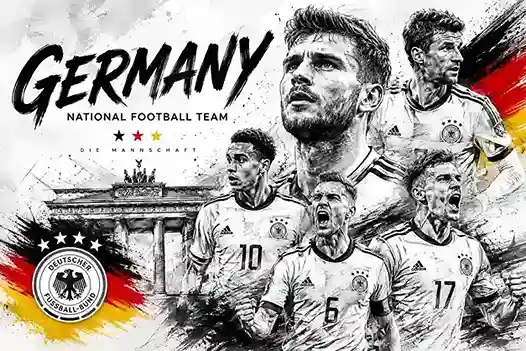
Germany national football team fans know the feeling. It’s the final minutes of a knockout match. The scoreboard is level. The crowd holds its breath — and then Die Mannschaft find a way. Four World Cup titles. Three European Championships. A playing legacy that stretches across generations. Yet in 2026, heading into a fresh World Cup on American soil, Germany arrives not as heavy favorites — but as a team with something to prove.
Why Is the German National Football Team Among the Most Powerful Teams in Football?
The Germany national football team is built on a foundation that few nations can match. Founded under the Deutscher Fußball-Bund (DFB) in 1900, the team played its very first official international in 1908 — a 3–5 defeat against Switzerland in Basel. Since that opening loss, Germany has never stopped climbing.
The team’s identity rests on four pillars that coaches and players carry across every generation:
- Tactical discipline — organized, structured, hard to break
- Mental toughness — famous for delivering in pressure moments
- Collective spirit — team before individual, always
- Technical quality — producing world-class players across every era
No other European nation has won more World Cups. That record alone tells the story of what this team represents.
How many World Cup victories has Germany had?
The Germany national football team has lifted the FIFA World Cup four times — in 1954, 1974, 1990, and 2014. Those titles span six decades of global football competition, placing Germany alongside Brazil and Italy at the very top of the all-time winners’ list.
| Year | Final | Result | Host Country |
|---|---|---|---|
| 1954 | Germany vs Hungary | 3–2 | Switzerland |
| 1974 | Germany vs Netherlands | 2–1 | West Germany |
| 1990 | Germany vs Argentina | 1–0 | Italy |
| 2014 | Germany vs Argentina | 1–0 (AET) | Brazil |
The 1954 victory carries a special name in German football culture — the “Miracle of Bern.” Germany arrived as underdogs against a Hungarian side that had gone four years unbeaten. What followed changed a nation.
In 2014, Germany became the first European team to win a World Cup staged in the Americas — sealing it with Mario Götze’s extra-time goal against Argentina in Rio.
What Is Germany’s Full Trophy Cabinet in International Football?
The Germany national football team holds one of the most decorated records in the sport. Here is a full breakdown of major international trophies:
| Competition | Titles | Years |
|---|---|---|
| FIFA World Cup | 4 | 1954, 1974, 1990, 2014 |
| UEFA European Championship | 3 | 1972, 1980, 1996 |
| FIFA Confederations Cup | 1 | 2017 |
| Olympic Games (West Germany) | 1 | 1976 |
Germany has reached a record 8 World Cup finals — more than any other nation in history. They have also appeared in 13 European Championships, holding the record for the most participations in that competition.
Who Are the Greatest Players in Germany’s Football History?
When football historians discuss legendary Germany players, certain names appear every time. These are the men who shaped the identity of this team over the decades:
Franz Beckenbauer — Known as “Der Kaiser,” Beckenbauer remains the only person to win the World Cup as both captain (1974) and head coach (1990). He revolutionized the sweeper position and is widely considered Germany’s greatest-ever player.
Miroslav Klose — The all-time top scorer at FIFA World Cups with 16 goals across four tournaments. His 71 international goals for the Germany national football team stood as a national record that held for decades.
Gerd Müller — “Der Bomber” scored 68 goals in just 62 international appearances, including the winning goal in the 1974 World Cup final. His finishing ability still serves as a benchmark.
With 150 appearances, Lothar Matthäus is Germany’s most-capped player. A World Cup winner and European Champion, he played with intensity and intelligence at the highest level.
Sepp Maier, Karl-Heinz Rummenigge, Uwe Seeler, Oliver Kahn — Each of these names carries the weight of a specific era. Germany national football team history is, in many ways, a history of these extraordinary individuals.
Who Are the Key Germany Players in the 2026 World Cup Squad?
Julian Nagelsmann named his 26-man squad for the 2026 World Cup on May 21, 2026. The selection carries an unusual mix of young brilliance and surprising experience — headlined by a goalkeeper who defied expectations to return.
Complete Germany 2026 World Cup Squad
Goalkeepers:
- Manuel Neuer (Bayern Munich) — 40 years old, reversed his international retirement for one final tournament
- Oliver Baumann (TSG Hoffenheim)
Defenders:
- Joshua Kimmich — Captain (Bayern Munich)
- Jonathan Tah (Bayern Munich)
- Nico Schlotterbeck (Borussia Dortmund)
- Antonio Rudiger — Vice-captain (Real Madrid)
- Waldemar Anton (Borussia Dortmund)
- Malick Thiaw (Newcastle United)
- David Raum (RB Leipzig)
- Nathaniel Brown (Eintracht Frankfurt)
Midfielders:
- Jamal Musiala (Bayern Munich)
- Florian Wirtz (Liverpool)
- Leon Goretzka (Bayern Munich)
- Aleksandar Pavlovic (Bayern Munich)
- Angelo Stiller (VfB Stuttgart)
- Felix Nmecha (Borussia Dortmund)
- Pascal Gross (Brighton & Hove Albion)
- Nadiem Amiri (1. FSV Mainz)
- Leroy Sané (Galatasaray)
- Jamie Leweling (VfB Stuttgart)
- Assan Ouédraogo (RB Leipzig) (replaced injured Lennart Karl)
Forwards:
- Kai Havertz (Arsenal)
- Deniz Undav (VfB Stuttgart)
- Nick Woltemade (Newcastle United)
- Maximilian Beier (Borussia Dortmund)
Seven of the 26 players represent Bayern Munich, underscoring the club’s enduring influence on German football.
Which Germany Players Are Carrying the Biggest Expectations at World Cup 2026?
Three names carry the brightest spotlights heading into this tournament:
Florian Wirtz (Liverpool)
Wirtz transferred from Bayer Leverkusen to Liverpool in 2025 for a record-breaking fee. At 23, he brings pace, sharp decision-making, and the technical skill to unlock defenses that sit deep. He missed the 2022 World Cup through injury, making 2026 his first taste of the tournament.
Jamal Musiala (Bayern Munich)
A broken leg suffered at the 2025 Club World Cup threatened his participation. He recovered — and Nagelsmann was clear: even at 95 percent, Musiala is among the best players on the planet. His dribbling, vision, and ability to score in tight spaces make him Germany’s most dangerous attacker when fully fit.
Joshua Kimmich (Bayern Munich) — Captain
Kimmich leads with calm authority. Operating at right-back under Nagelsmann for the national team, he reads the game earlier than most and drives the team’s structure when possession is won or lost. His leadership off the pitch is equally important inside the dressing room.
Deniz Undav also deserves mention — the VfB Stuttgart striker finished as the top German scorer in the Bundesliga during 2025/26 with 19 goals, making his World Cup selection obvious.
What Germany Matches Are Scheduled at World Cup 2026?
Germany is placed in Group E at the 2026 World Cup. Their three group-stage Germany matches are:
| Date | Fixture | Venue |
|---|---|---|
| June 14, 2026 | Germany 7–1 Curaçao | Houston |
| June 20, 2026 | Germany vs Côte d’Ivoire | Toronto |
| June 25, 2026 | Ecuador vs Germany | New York |
The opening result — a 7–1 win over Curaçao — sent an immediate statement. Felix Nmecha opened the scoring with a composed finish, and Kai Havertz also found the net. Deniz Undav made an impact from the bench, contributing a goal and two assists.
A potential knockout-stage meeting with France already has football fans circling their calendars.
How Has the Germany National Football Team Performed in Recent Years?
The past decade has been a complex chapter for the Germany national football team. The 2014 World Cup triumph in Brazil was the peak — and what followed tested German football’s patience.
- 2018 World Cup (Russia): Group-stage elimination after a shock defeat to South Korea
- 2020 UEFA Euro: Eliminated in the Round of 16 by England at Wembley
- 2022 World Cup (Qatar): Group-stage exit again, beaten by Japan on the way out
- Euro 2024: Tournament hosts, eliminated in the quarter-finals by Spain
These setbacks reshaped German thinking. Julian Nagelsmann took over in September 2023 with a clear brief — rebuild the style, restore the confidence, and return Die Mannschaft to where they belong. Germany’s World Cup 2026 qualifying campaign delivered five wins from six matches, including a memorable 4–2 result over Switzerland on the road.
The team that opens in Houston looks different in character from the one that exited in Qatar. Whether that difference is enough remains the central question of Germany’s 2026 campaign.
What Playing Style Does Julian Nagelsmann Use With Germany?
Julian Nagelsmann arrived as one of football’s most progressive tactical minds. At 28, he became the youngest head coach in Bundesliga history when he took charge of TSG Hoffenheim — and his methods have since been refined through stints at RB Leipzig and Bayern Munich.
At international level, Nagelsmann builds his Germany national football team around two connected ideas:
Gegenpressing after losing the ball — Germany attack transitions immediately after a turnover, pressing high to win possession back before opponents can settle.
Controlled possession going forward — when the ball is secure, Germany aim to dominate territory and create overloads through quick combination play.
The result is a team that presses with urgency but moves with purpose. Wirtz and Musiala thrive in this system — both are exceptional at receiving the ball in tight spaces and finding the next pass or carrying forward.
How Does Germany Compare to Other Top National Teams Historically?
When the question of the greatest national team in football history comes up, three names dominate the conversation:
| Nation | World Cup Titles | European/Continental Titles |
|---|---|---|
| Brazil | 5 | 1 |
| Germany | 4 | 3 |
| Italy | 4 | 2 |
| Argentina | 3 | 3 |
| France | 2 | 2 |
Germany sits second overall in terms of combined major international silverware. No European team has won more World Cups, and no team anywhere has reached more World Cup finals — their eight final appearances remain a global record.
Lothar Matthäus holds the record for most international caps in Germany history at 150. Miroslav Klose holds the record for most goals — 71 in total, including his unmatched 16 at World Cups.
What Does Germany’s World Cup 2026 Campaign Mean for the DFB and German Football?
The stakes extend beyond what happens on the pitch. German football has been rebuilding its identity since 2018, and a strong run in 2026 carries weight for the DFB (Deutscher Fußball-Bund), the Bundesliga’s global reputation, and an entire generation of Germany players who want to be remembered the way 2014’s squad is remembered.
The return of Manuel Neuer at 40 adds a symbolic dimension — a legendary goalkeeper choosing one final chapter, playing behind a team that carries genuine quality. The presence of Florian Wirtz and Jamal Musiala gives this squad a ceiling that few nations can claim.
A fifth World Cup title would tie Brazil’s all-time record. That possibility — however distant at the start of a tournament — fuels the ambition inside Nagelsmann’s camp.
6 Frequently Asked Questions About the Germany National Football Team
Q1: How many times has the Germany national football team won the World Cup?
Short Answer: Four times — in 1954, 1974, 1990, and 2014.
Germany’s four World Cup victories span Switzerland, West Germany itself, Italy, and Brazil as host countries. The 2014 win was particularly historic — it made Germany the first European side to win a World Cup held on South American soil.
Q2: Who is the all-time top scorer for the Germany national football team?
Short Answer: Miroslav Klose with 71 international goals.
Klose scored those goals across 137 appearances between 2001 and 2014. He is also the all-time leading scorer in World Cup history with 16 goals across four tournaments.
Q3: Who captains Germany at the 2026 World Cup?
Short Answer: Joshua Kimmich of Bayern Munich.
Kimmich has been a consistent choice as skipper under Nagelsmann. He plays at right-back for the national team and brings leadership that goes beyond the armband — he sets the tone in press situations and organizes the defensive shape.
Q4: Is Jamal Musiala fit for the 2026 World Cup?
Short Answer: Yes — he recovered from a serious leg injury and made the squad.
Musiala broke his leg at the 2025 Club World Cup, casting doubt over his involvement. He returned to action with Bayern Munich late in the season and was included by Nagelsmann, who stated that even at less than full sharpness, Musiala is among the world’s elite.
Q5: What is Germany’s nickname?
Short Answer: Die Mannschaft — German for “The Team.”
The Germany national football team also goes by DFB-Team and Nationalelf (National Eleven). “Die Mannschaft” became particularly popular after the 2014 World Cup campaign and has since been adopted widely in international football coverage.
Q6: Who is the head coach of Germany in 2026?
Short Answer: Julian Nagelsmann, appointed in September 2023.
Nagelsmann had previously managed TSG Hoffenheim, RB Leipzig, and Bayern Munich before taking the national team role. He won three trophies with Bayern in his two-year spell there and has since restored confidence inside the Germany squad ahead of the 2026 World Cup.
The Germany National Football Team Today: A Legacy Still Being Written
The Germany national football team carries more weight than any single trophy can measure. Four World Cups. Three European Championships. Record finals appearances. Generational players whose names — Beckenbauer, Klose, Müller, Musiala, Wirtz — remind the world what German football can produce at its best.
The 2026 World Cup is not just another tournament for Die Mannschaft. It’s the moment a new generation has the chance to carve their own chapter into this remarkable history. Florian Wirtz is playing his first World Cup. Jamal Musiala is proving his recovery. Joshua Kimmich is leading with everything he has. And Manuel Neuer — the greatest goalkeeper of his era — is making sure his final chapter ends on his own terms.
The football world is watching. And history suggests that when the moment matters most, Germany tends to find a way.
Follow Germany’s World Cup 2026 matches live and check back for squad updates, match previews, and in-depth analysis of every Germany game in Group E and beyond.
Sources: UEFA.com | FIFA.com | Bundesliga.com | Al Jazeera Sports | Olympics.com