Futz Meaning: Definition, Origin, and How to Use It
You’ve heard the phrase “stop futzing around” and paused, unsure of the futz meaning. Misinterpreting casual slang can leave you feeling disconnected in conversations. This guide quickly clears up the confusion.. You’ll learn exactly what “futz” means, its surprising Yiddish roots, and how to use it confidently in everyday speech.
What Does “Futz” Mean?
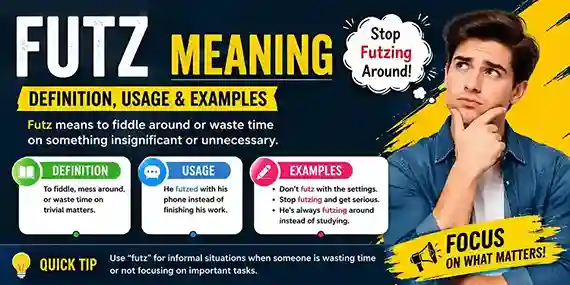
The futz meaning at its simplest: to waste time, fool around, or tinker in an aimless, often playful way.
When someone says they’re “futzing around,” they’re not doing anything productive.
The verb captures a sense of idle busyness — hands moving, but nothing getting done.
In modern American English, the futz meaning carries zero malice. It describes goofing off, fiddling with small objects, or puttering without a clear goal.
You’ll also hear “futz with” something, which shifts the futz meaning toward active but unskilled tinkering.
Both forms share the same core: lighthearted, unhurried activity.
The Yiddish Origin of “Futz”
The futz meaning didn’t start as a cute verb. It sprouted from a much earthier Yiddish word.
Yiddish speakers know the term putz (פּאָץ), which literally refers to the male organ.
Over time, putz also became a sharp insult for a foolish or obnoxious person.
Linguists point to a phonetic softening — putz morphing into futz — as Jewish immigrants wove their speech into American slang.
The Merriam-Webster dictionary traces the first recorded use of “futz” as a verb to the 1960s.
The Yiddish cultural outlet The Forward notes that many once-vulgar Yiddish words lost their sting when they entered everyday English as verbs.
Thus the futz meaning transformed from something crude into something you can say at the dinner table without a blush.
The Online Etymology Dictionary anchors the shift in mid-20th-century urban speech, where “futz around” emerged as a gentle way to describe procrastination or meddling.
Is “Futz” a Vulgar Word?
No. The verb form of futz meaning carries no vulgar charge today.
The original Yiddish noun remains coarse, but the English verb has wandered far from its ancestor.
Think of how “screw” works — the noun can be crude, yet “screw around” or “screw up” functions as casual, non-offensive slang.
You can safely use “futz” around kids, in offices with friendly banter, and on podcasts.
It lands with the same weight as “fiddle” or “mess around.”
That said, avoid calling a person a futz. That noun usage, while rare, still echoes the Yiddish insult.
Stick to the verb forms, and the futz meaning stays completely harmless.
“Futz Around”: Meaning and How to Use It
“Futz around” is the most common way people express the futz meaning.
It means to loaf, stall, or occupy yourself with trivial things instead of what you should be doing.
You aren’t necessarily being lazy; you’re just not focusing.
Picture someone straightening pencils, scrolling their phone, or re-folding a blanket for the third time. That’s futzing around.
Use it when you want to describe procrastination with a shrug instead of judgment.
For instance: “Instead of writing the report, I fiddled around all morning.””
Example: “Stop futzing around and grab your coat — we’re late.”
The phrase injects a bit of Yiddish-inflected humor into an otherwise annoying habit.
“Futz With”: Tinkering or Meddling?
When the futz meaning travels with the preposition “with,” it shifts from pure idleness to hands-on fiddling.
“Futz with” means to toy with an object, adjust something repeatedly, or try to fix something without real expertise.
You might futz with a stubborn zipper, a guitar tuner, or a crooked picture frame.
It suggests motion without mastery — you’re manipulating, but not necessarily improving.
- He futzed with the thermostat all evening and never got the temperature right.
- She futzed with her necklace while she talked, a nervous habit.
- Don’t futz with the settings; you’ll make the screen too dark.
This variation of the futz meaning shines when you want to describe small, restless adjustments.
Real-Life Examples of “Futz” in Sentences
Seeing the futz meaning in different contexts makes it stick.
Here are real-world sentences that show how native speakers use the word naturally.
- I can’t focus — I just keep futzing around on my phone.
- Grandpa loves to futz with his old radio, even though it works fine.
- Quit futzing with the car engine if you don’t know what you’re doing.
- We futzed around the house all weekend; it felt wonderful.
- Whenever she’s nervous, she futzes with her ring.
- They missed the bus because they were futzing with their shoelaces.
Each sentence keeps the futz meaning light, conversational, and precise without being formal.
Futz Variations at a Glance
| Expression | Meaning | Example Sentence |
| futz around | Waste time, procrastinate idly | I futzed around instead of studying. |
| futz with (something) | Tinker with, meddle or fiddle aimlessly | He keeps futzing with the volume dial. |
| just futzing | Engaging in goalless activity | She’s just futzing; she’ll get serious later. |
This table clarifies how small word changes nudge the futz meaning toward loafing or tinkering.
How “Futz” Differs from Similar Slang
English overflows with verbs for idle behavior, so why pick “futz”?
The futz meaning splits the difference between “fiddle,” “tinker,” “mess around,” and “putter.”
- Fiddle implies tiny manual adjustments, often on something delicate.
- Tinker suggests amateur repair work with at least a hint of purpose.
- Mess around can mean joking, flirting, or general time-wasting — broader than futz.
- Putter is gentle and domestic, like tending to houseplants without urgency.
“Futz” carries a Yiddish rhythm that sounds more playful and self-deprecating.
When you say you’re “futzing around,” you admit you’re being unproductive, but you don’t sound harsh about it.
That tonal softness makes the futz meaning perfect for friendly, everyday speech.
Why People Love Using “Futz” in Casual Speech
The futz meaning thrives in spoken English because it sounds exactly like what it describes — soft, fuzzy, and unthreatening.
The “f” and “tz” sounds give the word a comedic bounce that’s hard to replicate with “idle” or “procrastinate.”
Yiddish-origin words often land with warmth in American conversation.
Terms like schlep, nosh, and kvetch bring texture and personality. “Futz” fits right into that family.
Using “futz” signals you don’t take yourself too seriously.
It invites the listener to share a small, relatable moment of human imperfection.
That’s the emotional core of the futz meaning — a word that turns laziness into a gentle, shared joke.
Common Mistakes When Using “Futz”
Even with a clear futz meaning, a few errors trip people up.
- Using “futz” as a noun: Calling someone a futz drags the word back to its vulgar Yiddish root. It sounds old-fashioned and potentially offensive. Stick to verb forms.
- Overusing it in formal writing: The futz meaning belongs to casual blogs, dialogue, and friendly emails. Don’t drop it into a business proposal.
- Missing the preposition: “Futz around” and “futz with” aren’t interchangeable. “Futz around” = waste time; “futz with” = physically tinker. Mixing them up blurs the meaning.
- Applying it to serious mistakes: Futzing is minor. If someone breaks a priceless vase, they didn’t “futz around” — they caused damage. The futz meaning stays safely in low-stakes territory.
Keep these guardrails in mind, and you’ll wield the word like a native.
The Evolution of “Futz” in American English
The futz meaning hit its stride in the 1960s and 1970s, a period when Yiddish-infused comedy dominated television and stand-up.
Writers for sitcoms peppered scripts with schmooze, spiel, nudge, and, yes, futz around.
Comedians like Joan Rivers and Jerry Seinfeld’s writing team brought Yiddish cadences to mainstream audiences.
In a famous Seinfeld exchange, characters muse about “futzing and puttering,” which helped cement the verb in the cultural lexicon.
Merriam-Webster added “futz” as an intransitive verb in subsequent editions, acknowledging its staying power.
Linguist Ben Zimmer has written about how such words move from immigrant speech to ubiquitous slang, noting that the futz meaning retained its playful core while shedding its taboo.
Today, you’ll hear the word in podcasts, parenting blogs, and casual workplaces.
It’s a small language success story — a rough-edged Yiddish noun reborn as an all-American verb.
How to Add “Futz” to Your Vocabulary Naturally
The futz meaning slips into your vocabulary best when you attach it to real, low-stakes moments.
Try these practical approaches.
- Start with “futzing around” in self-talk: When you catch yourself avoiding a task, say, “I’m just futzing around.” It reframes procrastination without guilt.
- Use “futz with” for gadgets: Next time you tap settings on your phone without purpose, narrate it: “I keep futzing with the brightness.”
- Try it with close friends and family first: The word feels most natural among people you’re relaxed with.
- Don’t force it: Use “futz” when the moment calls for lightness. If you’re angry or rushed, “futz” will feel out of place.
- Listen for it: You’ll start noticing “futz” in movies, series, and casual YouTube commentary. Each time you hear it, the futz meaning becomes more instinctive.
Within a week, you’ll find yourself using it without thinking — and smiling when you do.
Frequently Asked Questions About “Futz Meaning”
What is the exact futz meaning?
The futz meaning is straightforward: to waste time idly or tinker with something in a casual, aimless way. You “futz around” when you procrastinate, and you “futz with” an object when you fiddle with it without real purpose.
Where did the word futz come from?
Futz traces back to the Yiddish word putz, a vulgar term for the male organ that later evolved into an insult for a fool. When Yiddish speakers brought the word into American English, the futz meaning softened into a harmless verb describing idle behavior.
Is it offensive to use futz?
No. The verb “futz” is completely inoffensive in modern English. The original Yiddish noun retains a coarse edge, but the verb form carries zero shock value. However, avoid calling a person “a futz,” which can still sound insulting.
What’s the difference between “futz around” and “futz with”?
“Futz around” refers to wasting time or loafing. “Futz with” means physically tinkering or meddling with an object. The futz meaning shifts from pure idleness to hands-on fiddling depending on the preposition.
Can I use futz in professional writing?
Keep the futz meaning out of formal reports, academic papers, and official correspondence. It belongs in conversational writing — blog posts, personal emails, dialogue, and social media. In professional settings, choose “adjust” or “tinker” instead.
What are synonyms for futz?
Common synonyms include fiddle, tinker, mess around, putter, and fool around. Each word carries slightly different weight, but they all orbit the same futz meaning of light, goalless activity.
Stop Futzing and Start Using the Word
The futz meaning gives you a playful, zero-pressure way to talk about wasted time and restless hands.
Now you know it came from Yiddish, settled into American slang, and works best when life feels informal.
Next time you catch yourself aimlessly adjusting a lamp or scrolling without purpose, say it out loud: “I’m futzing.”
If you enjoyed cracking open the futz meaning, drop a comment with another Yiddish-derived word you want decoded.
Share this guide with a friend who loves language quirks.
And stop futzing around — you’ve got a great new word to use today.