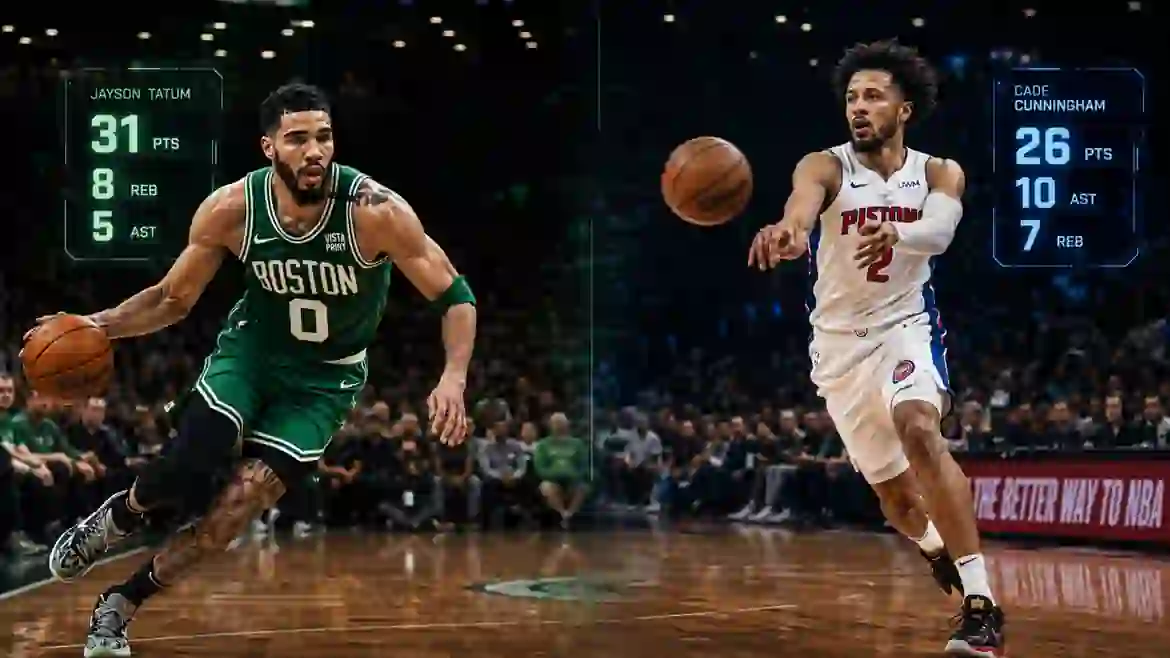
The hardwood told a story that numbers alone cannot capture. When the Detroit Pistons vs Celtics match player stats clash, every possession carries weight, every shot attempt adds a chapter. Jayson Tatum dropped 31 points while Cade Cunningham answered with a double-double that kept Detroit within striking distance all night. This breakdown covers every rebound grabbed, every assist dished, and every defensive stop that shaped the outcome.
Starting Five Production: Celtics Core Delivers Again
Jayson Tatum needed 34 minutes to record 31 points, 8 rebounds, and 5 assists. His first-quarter aggression set an immediate tone, attacking closeouts and drawing fouls on three separate drives before the six-minute mark. Shooting 11-of-23 from the field and 4-of-9 from deep, Tatum forced Detroit to send help defenders constantly.
Jaylen Brown added 24 points, 6 rebounds, and 3 assists on efficient 9-of-16 shooting. His mid-range pull-up game punished Detroit’s drop coverage repeatedly during the second quarter stretch that pushed Boston’s lead to double digits.
Kristaps Porzingis anchored the paint with 18 points, 11 rebounds, and 4 blocks. His rim protection altered at least six additional shots that never appeared in the box score. Detroit shot just 41% inside the restricted area when Porzingis patrolled the lane.
Jrue Holiday contributed 14 points, 7 assists, and 3 steals. Derrick White rounded out the starting unit with 11 points, 4 rebounds, and 4 assists while playing his typical disruptive perimeter defense.
Pistons Starting Unit: Cunningham Leads the Charge
Cade Cunningham posted 26 points, 10 assists, and 7 rebounds in 36 minutes. His court vision created open looks for teammates throughout the third quarter, where Detroit outscored Boston by 4 points. Shooting 10-of-20 overall, Cunningham demonstrated the complete offensive package that makes him Detroit’s franchise cornerstone.
Jaden Ivey scored 19 points and dished up five assists while continuously hitting the rim. His speed in transition produced 8 fast-break points that kept pressure on Boston’s defense. Ivey’s development as a secondary playmaker continues showing tangible results.
Jalen Duren grabbed 14 rebounds including 5 on the offensive glass, adding 10 points for a double-double. His physicality against Boston’s frontcourt created second-chance opportunities that generated 12 extra points for Detroit.
Ausar Thompson contributed 8 points, 5 rebounds, and excellent perimeter defense. Isaiah Stewart chipped in 6 points and 4 rebounds before foul trouble limited his minutes.
Bench Impact Comparison Table
| Player | Minutes | Points | Rebounds | Assists | Plus/Minus |
| Payton Pritchard (BOS) | 22 | 12 | 3 | 4 | +8 |
| Al Horford (BOS) | 24 | 8 | 7 | 3 | +11 |
| Sam Hauser (BOS) | 16 | 6 | 2 | 1 | +3 |
| Marcus Sasser (DET) | 18 | 9 | 2 | 3 | -5 |
| Simone Fontecchio (DET) | 20 | 7 | 4 | 1 | -6 |
| James Wiseman (DET) | 10 | 4 | 5 | 0 | -9 |
Payton Pritchard gave Boston instant offense off the pine, sinking three triples during a crucial second-quarter run. Al Horford’s veteran presence stabilized the second unit defensively while knocking down two corner threes. Marcus Sasser showed scoring punch for Detroit but struggled containing dribble penetration.
Team Stat Comparison
Boston shot 48.3% from the field compared to Detroit’s 43.7%. The three-point disparity proved decisive — Celtics connected on 16-of-39 attempts (41%) while Pistons managed 9-of-28 (32%). Boston’s ball movement generated 28 assists on 42 made baskets, showcasing the system that consistently produces high-quality looks.
Rebounding finished nearly even with Boston securing 46 boards to Detroit’s 44. Turnovers favored the Celtics, who forced 15 Pistons giveaways while committing only 10 themselves. Those extra possessions translated into 19 points off turnovers.
Free throw attempts told another story. Detroit earned 24 trips to the line but converted just 17. Boston’s 22 attempts yielded 19 makes, an 86% clip that protected their lead during fourth-quarter intentional fouling situations.
Quarter-by-Quarter Scoring Flow
The opening period belonged to Boston’s starters, who built an 8-point cushion behind Tatum’s 12 first-quarter points.In the second session, Cunningham orchestrated pick-and-roll plays that resulted in clean mid-range chances, giving Detroit is attack rhythm.
The third quarter featured Detroit’s best basketball. Ivey pushed tempo relentlessly, Duren controlled the defensive glass, and Cunningham found cutters for easy baskets. Detroit trimmed the deficit to 5 points entering the final period.
Boston’s closing lineup seized control with a 12-2 run to open the fourth. Holiday forced two consecutive turnovers, Tatum converted a four-point play, and Porzingis swatted Cunningham’s driving attempt that effectively sealed the outcome with four minutes remaining.
Defensive Standouts and Hidden Contributions
Jrue Holiday’s three steals only partially reflect his defensive impact. He deflected seven passes, contested nine shots, and held Detroit’s guards to 4-of-14 shooting when serving as the primary defender. His ball pressure disrupted Detroit’s offensive timing consistently.
Porzingis altered Detroit’s entire shot selection philosophy. Pistons players passed up eight viable looks at the rim, opting instead for contested mid-range jumpers that Boston’s defense happily conceded. This rim deterrence represents Porzingis’s most valuable contribution.
Ausar Thompson drew the unenviable assignment of guarding Tatum for 22 possessions. While Tatum still produced, Thompson forced him into 4-of-11 shooting during those matchups — a meaningful victory in an otherwise difficult defensive task.
Advanced Metrics That Defined the Outcome
Boston posted a 122.4 offensive rating compared to Detroit’s 108.7, reflecting the efficiency gap that separated these teams. Pace favored the Pistons at 101.3 possessions, yet faster tempo played into Boston’s transition strengths.
True shooting percentage highlighted the scoring efficiency difference. Boston recorded a 59.8% TS while Detroit managed just 52.1%. This single metric encapsulates why the Pistons could not complete their comeback despite multiple surges.
Assist percentage told a similar story. Boston assisted on 66% of made field goals versus Detroit’s 54%, evidence of the half-court execution advantage that Joe Mazzulla’s system provides. When Tatum or Brown face double teams, Boston’s role players consistently make the correct read.
FAQs About Detroit Pistons vs Celtics Match Player Stats
Who scored the most points in the Detroit Pistons vs Celtics match player stats?
Jayson Tatum led all scorers with 31 points on 11-of-23 shooting, including 4 three-pointers and perfect 5-of-5 free throw shooting across 34 minutes of action.
What were Cade Cunningham’s full stats in this Pistons Celtics matchup?
Cade Cunningham recorded 26 points, 10 assists, and 7 rebounds while shooting 50% from the field. His double-double performance kept Detroit competitive throughout the second half despite Boston’s overall advantage.
How did the bench players perform based on the Detroit Pistons vs Celtics match player stats?
Boston’s bench outscored Detroit’s reserves 26-20. Payton Pritchard contributed 12 points including three made three-pointers, while Marcus Sasser led Detroit’s bench production with 9 points.
Which Celtics player had the most rebounds according to the Detroit Pistons vs Celtics match player stats?
Kristaps Porzingis grabbed 11 rebounds to complement his 18 points and 4 blocks. Jalen Duren led all rebounders with 14 boards for Detroit, including 5 offensive rebounds.
What was the three-point shooting difference in this Pistons vs Celtics game?
Boston converted 16-of-39 three-point attempts (41%) while Detroit managed only 9-of-28 from beyond the arc (32%). This 7-made-three differential proved insurmountable for the Pistons.
How many assists did the Celtics record compared to Detroit in the latest matchup?
Boston dished 28 assists on 42 made field goals, a 66% assist rate. Detroit recorded 22 assists on 37 made baskets for a 59% assist rate, reflecting the gap in half-court execution.
The box score tells part of the story, but watching Tatum’s first-quarter dominance, Holiday’s defensive disruption, and Cunningham’s determined response reveals the full picture. Boston’s superior shooting efficiency and veteran execution ultimately proved too much for a young Pistons squad that continues showing legitimate growth.
For fans tracking every stat line from this Eastern Conference matchup, the numbers confirm what the eye test suggested — Boston’s championship habits separate them even on nights when Detroit brings legitimate fight. Bookmark this page for updated Detroit Pistons vs Celtics match player stats throughout the season, and share these insights with fellow basketball fans who demand detailed performance analysis.