Best Puzzle Boards That Actually Save Your Sanity in 2026
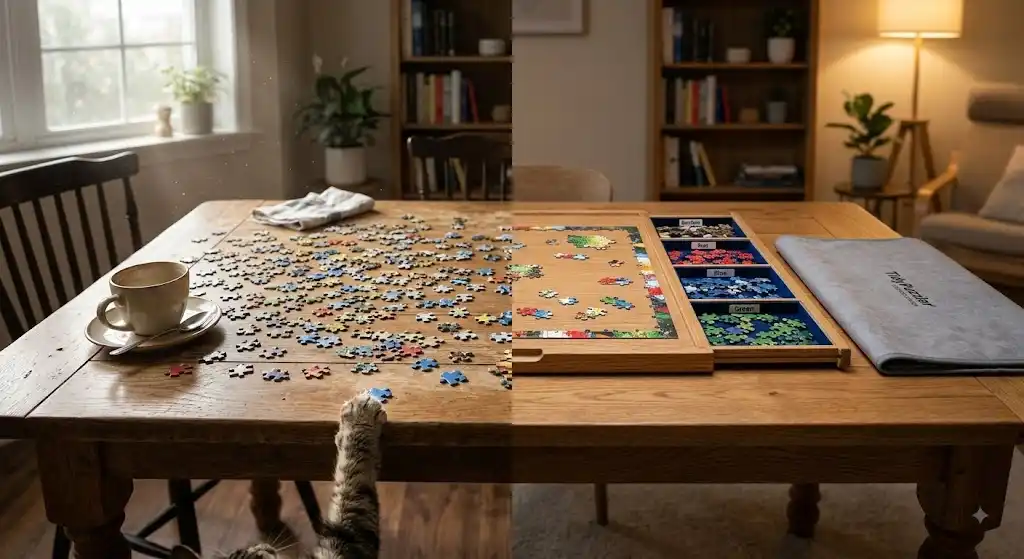
You know that sinking feeling. You walk past the dining table, and there it is. A half-finished 1000-piece landscape, completely covered in a fine layer of dust, with one crucial corner piece mysteriously vanished. Maybe the cat knocked it off. Maybe the kids used the border pieces as makeshift frisbees.
A dedicated puzzle board isn’t a luxury; it’s the only thing standing between your mental peace and a floor full of cardboard chaos. If you’re serious about keeping your hobby alive without sacrificing your living space, you need a system that sorts, covers, and hides the mess in seconds.
This isn’t just a buying guide. I’m going to show you exactly how to pick a surface that doubles your speed, protects your progress, and looks decent enough to leave out when guests arrive.
What a Puzzle Board Is and Why You are Missing It
A puzzle board is a flat, rigid surface specifically crafted to assemble jigsaw puzzles on. It’s fundamentally different from a standard table. It creates a defined boundary for your project, preventing the slow creep of pieces taking over the entire house. But the real magic goes way beyond a simple wooden slab. Modern designs act as a complete mobile workstation.
They combine a smooth workspace with a non-slip surface that grips your pieces, integrated sorting trays so you aren’t sifting through a plastic bag like a raccoon in a trash can, and a protective cover that seals everything tight. This turns any jigsaw puzzle into a stowable activity. You can slide the whole thing under the couch in ten seconds flat. That’s the freedom a good surface buys you.
Why a Cardboard Box Loses Every Time
The flimsy cardboard flap the puzzle came in is a disaster waiting to happen. It warps, the edges snag, and it offers zero protection against humidity or a rogue glass of water. A hard puzzle board with a cover is a different beast entirely. The cover acts as a shield, keeping dust and pet hair out of the grooves. If you have cats, you know exactly what I mean.
They see loose pieces as toys. A rigid, zippered or felt-lined cover eliminates that risk. You’re not just storing a puzzle; you’re locking down a project in suspended animation, ready to resume the exact second you get a free hour.
The 2026 Standouts: Puzzle Board Options Worth Your Money
There isn’t one “perfect” model for everyone. The right choice depends entirely on your puzzling style. Some of you are casual 500-piece solvers who need something cheap and light. Others are tackling 5000-piece monsters that take six months and require a rotating puzzle board to save your back from snapping in half. I’ve broken down the top contenders for every scenario right now.
| Product Type | Best For | Key Feature | Estimated Price Point |
| Wooden Puzzle Board with Drawers | 1000-2000 piece puzzles | Magnetic sorting bins & smooth fiberboard | $$$ |
| Premium Rotating Lazy Susan | Large formats & back pain | 360-degree glass-like rotation | $$$$ |
| Lightweight Felt Mat Roll-Up | Travelers & tight spaces | Roll-up fabric with inflatable tube | $ |
| DIY Cardboard & Foam Board | Budget-conscious crafters | Customizable sizing, zero shipping cost | $ |
The Organized Genius: Puzzle Board with Drawers
If you’re a heavy user, stop looking at basic mats. A puzzle board with drawers is the equivalent of a master chef’s prep station. These units typically feature four side drawers that slide out smoothly, allowing you to sort pieces by color or pattern without covering the main image.
The best part? The magnetic finish keeps the drawers sealed shut when you tip the board upright. You can literally store this vertically behind a door. It changes the game for apartment dwellers.
The surface is usually a high-quality composite wood that won’t warp, giving you that satisfying “click” when you lock a piece in. This is the long-term investment that actually finishes puzzles faster.
The Back-Saver: Rotating Puzzle Board
Spending hours leaning over a table, craning your neck to reach a far corner, is a recipe for a very angry spine.
A rotating puzzle board sits on a sturdy Lazy Susan base. It spins effortlessly. You plant yourself in one comfortable chair, and the puzzle comes to you. No more standing up to check the reference image upside down.
This style is a godsend for large-format 3000+ piece landscapes where the top left corner feels a mile away from the bottom right. The base is heavy, so it won’t slide, and the rotation is smooth enough that your unfinished sections won’t scatter. That’s critical—a jerky spin is worse than no spin at all.
How to Create a Puzzle Board Without Investing a Lot of Money
Not everyone wants to drop serious cash on a manufactured board. Maybe you’re running out of storage space and need custom dimensions. That’s where a DIY puzzle board comes in clean. You can construct a fully functional, professional-grade board with a single trip to the hardware store and about twenty dollars. You don’t need master carpentry skills.
The goal here is function over fashion: a lightweight, rigid panel that you can move from room to room without flexing and destroying your hard work. Store-bought versions are great, but a custom board fits your exact shelf dimensions perfectly.
How to Build a Puzzle Board That Lasts Years
To build a puzzle board that won’t warp, start with a half-inch thick foam board or a sanded plywood sheet. Cut it to a size that leaves at least a three-inch border around your largest expected puzzle size. Don’t use thin poster board; it bends the second you lift it, launching pieces into orbit. Sand the edges smooth so they don’t catch on clothing or carpet. The surface needs grip.
Lay a sheet of adhesive felt or non-slip shelf liner down flat. This creates a high-friction surface where pieces stay put even at a slight angle. Finally, build a simple framed edge using flat trim wood. This border is your insurance policy against the “slide of death” when moving the board to the closet.
How to Make a Puzzle Board Out of Cardboard
If you need a zero-cost solution today, learn how to make a puzzle board out of cardboard. Find a large, thick, double-walled shipping box. Cut one large flat rectangle and glue two or three layers of corrugated cardboard together, alternating the grain direction.
This cross-lamination creates a very strong, rigid panel that resists bending. Tape the edges with duct tape to prevent peeling. As a cover, use a second flattened cardboard sheet and secure it over the top with large rubber bands or lightweight clamps. This won’t survive a flood, but it’s perfect for sliding under a bed and keeping the dust off a work-in-progress for free.
Finding Your Match: A Smart Buying Guide
Walking into a store or browsing online listings can feel overwhelming. You need a mental checklist to weed out the junk.
The surface material is non-negotiable. Cheap velvet or thin felt mats shed fibers that get stuck in the puzzle piece grooves. You want a tight, microfiber or dense wool surface that grips without residue. Next, check the edge lip. It must be at least half an inch high.
Any lower, and your sorting drawers or trays are useless because pieces will skid right over the side during a rotation or a nudge. Look for a puzzle board nearby first. Shipping on large wooden panels can be brutal, and local game stores often carry the high-end stuff without the freight risk of damage.
Where Can I Buy a Puzzle Board That Fits My Style
A surprising variety of mats and basic boards may be found in physical stores like Barnes & Noble, specialty hobby shops, and craft stores like Michaels.
The seasonal aisle at Aldi puzzle board drops has also become a cult phenomenon for budget shoppers. Those sell out in hours. Online, the variety is obviously unmatched. Amazon offers the most extensive range of rotating and drawer-based boards, but you have to watch the reviews for warped wood upon delivery.
Specialty jigsaw retailers online pack their products with extreme care and often include custom plate mats as a bonus. Start local, feel the material with your hands, then compare prices online before committing.
How to Glue a Puzzle to a Board for Permanent Display
Maybe you aren’t storing it. Maybe you finished a masterpiece and want it on the wall forever. To glue a puzzle to a board, don’t just pour liquid glue on top; it seeps between the cracks, gluing your board into a sticky brick. Slide a sheet of wax paper under the completed image.
Then, apply specialized puzzle glue or a decoupage medium directly to the front image with a plastic squeegee, scraping it smoothly across the surface. The glue creates a transparent, flexible sheet that binds the interlocking teeth together.
Once it dries, flip the whole thing carefully and apply a spray adhesive to the back of the puzzle and the board. Press firmly, let it cure, and you’ve got a permanent, hangable art piece that won’t shed pieces.
Frequently Asked Questions About Puzzle Boards
What is the best puzzle board for a 1000-piece puzzle?
The best puzzle board for a standard 1000-piece puzzle needs a workspace of at least 28 by 36 inches. Look for a puzzle board with drawers. This size gives you a generous border for sorting colors into the trays while keeping the full image in view. A wooden puzzle board with a non-slip felt top prevents accidental shifts. The drawers eliminate the need for separate sorting bins cluttering up your table, making the whole process cleaner and faster.
How does a puzzle board with a cover help pet owners?
A puzzle board with cover is pet-proof. The cover, whether it’s a rigid wooden lid or a thick translucent plastic protector, sits flush against the pieces. If a cat jumps up, it lands on the cover, not the loose pieces. No claws snag the image. No fur drifts into the crevices. It also allows you to stack books or a laptop on top of the puzzle board, effectively turning your project into a temporary coffee table.
Why would I need a rotating puzzle board?
You need a rotating puzzle board to eliminate the “walk-around.” Instead of getting up to work on different sections, you spin the board. This reduces back and neck pain significantly during long sessions. A rotating puzzle board also lets you view the image from different angles, which often reveals color pattern matches you completely missed when looking at the puzzle upside down.
Can I find a quality puzzle board near me?
Yes, finding a puzzle board near me is easier than you think. Avoid generic department stores and check local hobby shops or gaming cafes. These retailers often stock high-end European brands that don’t ship well. Buy-and-sell apps are another option for reselling Aldi puzzle boards. Picking up a puzzle board nearby saves you the heartbreak of receiving a cracked wooden edge from careless couriers.
Is the budget Aldi puzzle board worth the hype?
The Aldi puzzle board, usually dropping in early January, is a solid entry-level buy for the price. It’s lightweight and includes basic sorting trays. However, it usually lacks the heavy-duty non-slip base of premium models. For casual 500-piece puzzles, it’s a steal. For a 2000-piece project, you’ll find the rotation rough and the material slightly flimsy. It’s a great backup or starter board, not a legacy piece.
How do I stop my DIY board from sliding around?
When you make your own puzzle board, the table grip is critical. Head to a dollar store and buy a roll of rubberized shelf liner. Attach strips of it with glue to the lower corners of your homemade puzzle board. This creates friction against the table. Without this grip, the lightweight surface of a homemade board will slide away from you every time you try to press a tight piece down.
How may a puzzle be adhered to a board permanently?
To glue a puzzle to a board cleanly, first seal the front image with a clear-drying liquid puzzle glue. Let it dry for two hours. This locks the pieces together. Then, spread Mod Podge or a spray adhesive on the backing board, not the puzzle back. Carefully lay the sealed puzzle onto the glue, cover with parchment paper, and use a rolling pin to smooth bubbles out. This method ensures no glue squeezes up through the cracks.