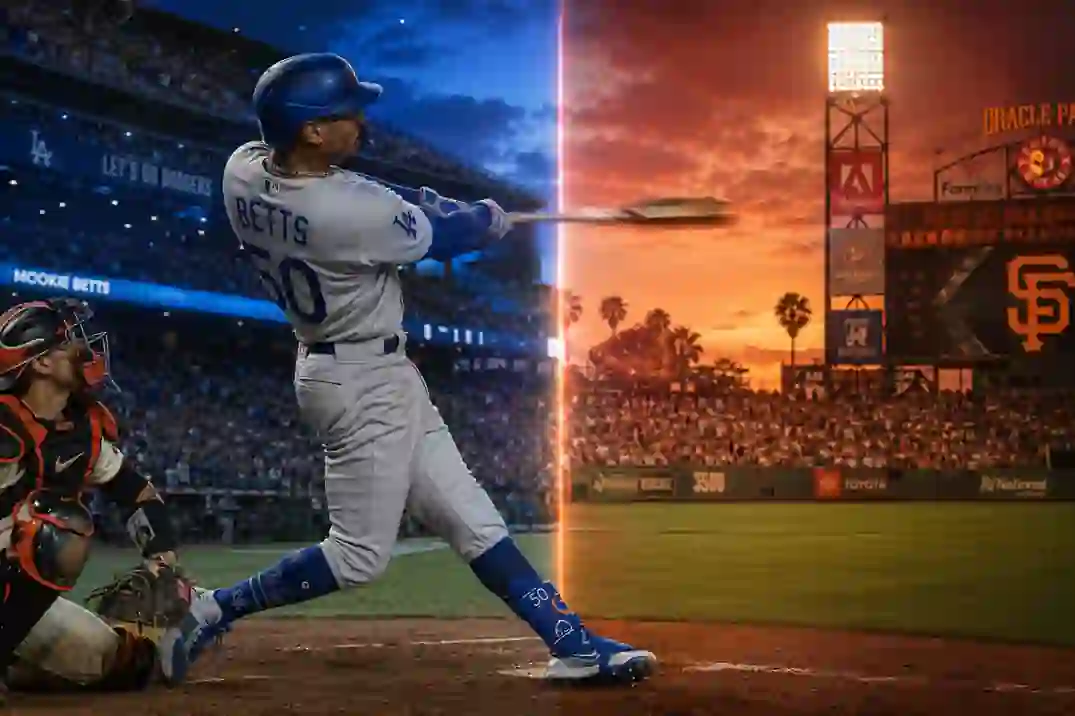
The Dodgers vs San Francisco Giants match player stats from their latest face-off paint a clear picture of a rivalry that never disappoints. Mookie Betts launched a decisive three-run homer in the seventh inning, shattering a 2-2 deadlock at Oracle Park. The visiting Dodgers rode that late-game thunder to a 6-3 victory, leaning on lights-out relief work and one colossal swing.
For fans and analysts digging into the Dodgers vs San Francisco Giants match player stats, this contest delivered clutch performances, defensive gems, and the electric tension that defines this historic NL West feud.
Offensive Firepower: Dissecting Dodgers vs San Francisco Giants Match Player Stats at the Plate
The Dodgers’ lineup manufactured runs through patience and power. Mookie Betts finished 2-for-4 with a walk, the home run, and four RBIs, anchoring the middle of the order. Freddie Freeman went 3-for-5 with two doubles and scored twice, constantly applying pressure from the two-hole.
Will Smith chipped in a 2-for-4 night and drove in a critical insurance run in the eighth. Shohei Ohtani reached base three times, recording a single, a stolen base, and a walk that set the table for Betts’s blast. Los Angeles tallied ten hits overall and drew five walks, forcing San Francisco pitchers to work from behind in the count all evening.
Giants’ Response: A Closer Look at Dodgers vs San Francisco Giants Match Player Stats for the Home Side
San Francisco’s bats flashed early but faded late. Jung Hoo Lee collected three hits in four trips, including a ringing double off the right-field wall that sparked a two-run rally in the third. Matt Chapman smashed a solo homer to left-center in the fourth, briefly giving the Giants a lead they could not hold.
Wilmer Flores added two singles and a sacrifice fly that pushed across the team’s third run. Thairo Estrada, normally a sparkplug, went hitless in four at-bats and struck out twice in run-scoring situations. The Giants left eight men on base, a statistic that haunted them against a Dodgers bullpen that refused to bend.
Starting Pitching Breakdown in Dodgers vs San Francisco Giants Match Player Stats
Yoshinobu Yamamoto took the ball for Los Angeles and grinded through five innings. He surrendered three earned runs on six hits, struck out seven, and walked one. His splitter generated fourteen swings and misses, keeping San Francisco hitters off balance even when they squared up the fastball. Opposing him, Logan Webb delivered a quality start for the Giants.
Webb logged six innings of two-run ball, scattered seven hits, and fanned five while walking none. The Dodgers vs San Francisco Giants match player stats show Webb exited with the score tied 2-2, handing a winnable game to his relief corps.
Bullpen Drama Reflected in Dodgers vs San Francisco Giants Match Player Stats
The game pivoted on the seventh-inning relief battle. Taylor Rogers entered for San Francisco and immediately walked Ohtani on four pitches. He then hung a slider that Betts deposited into the left-field seats, a swing that broke the contest open.
Evan Phillips slammed the door for Los Angeles with a six-out save, striking out four Giants hitters and allowing only a harmless single. His four-seamer touched 98 mph, and his cutter drew helpless swings from both Chapman and Flores. Brusdar Graterol bridged the sixth with a clean frame that required just eleven pitches.
Defensive Standouts and Missed Opportunities
Fielding plays often tip a rivalry game, and this one was no different. Miguel Rojas made a diving stop at shortstop in the fifth inning, robbing Michael Conforto of a base hit up the middle and starting an inning-ending double play. On the Giants’ side, Mike Yastrzemski cut down Freeman at third base with a pinpoint throw from right field, erasing a potential big inning in the fourth.
However, catcher Patrick Bailey committed a passed ball that allowed James Outman to scamper from second to third, eventually scoring on a sacrifice fly. Those slim margins show up repeatedly when studying Dodgers vs San Francisco Giants match player stats.
Game-Changing Inning Analyzed Through Dodgers vs San Francisco Giants Match Player Stats
The top of the seventh proved the definitive stretch. Ohtani worked a patient walk. Freeman moved him to second with a sharp single through the right side. Rogers then faced Betts with two on and nobody out.
The count ran to 2-1 before Betts unloaded on a hanging slider, sending it 412 feet at 108.9 mph exit velocity. The three-run shot flipped a 2-2 tie into a 5-2 Dodgers advantage. Statcast data rated the blast as a 99% hit probability in all thirty ballparks, underscoring the sheer authority of the swing.
Pitch-by-Pitch Trends from Dodgers vs San Francisco Giants Match Player Stats
Dodgers hitters forced San Francisco pitchers into thirty-two deep counts, defined as plate appearances reaching ball three or two strikes. That grind-it-out approach elevated pitch counts and exposed the Giants’ middle-relief depth. Webb needed ninety-seven pitches to navigate six innings, despite recording fifteen ground-ball outs. Yamamoto relied heavily on his splitter in two-strike counts, throwing it forty-one percent of the time. Hitters whiffed on that pitch at a 46% clip, the highest swing-and-miss rate of any offering thrown more than ten times in the game.
Historical Context for Dodgers vs San Francisco Giants Match Player Stats
This chapter adds another layer to baseball’s most storied rivalry. The two clubs have now faced each other over 2,500 times since their New York days. Recent meetings continue to tilt toward Los Angeles, who have captured nine of the last thirteen regular-season matchups at Oracle Park.
Betts’s home run marked his fifteenth career blast against the Giants, the most he has hit against any single opponent. These Dodgers vs San Francisco Giants match player stats reflect a modern rivalry where star talent and depth decide outcomes with razor-thin margins.
Managerial Decisions That Shaped Dodgers vs San Francisco Giants Match Player Stats
Dave Roberts pushed the right buttons in the late innings. His decision to call on Phillips for a six-out save, rather than mixing and matching, locked down a lineup that had threatened earlier.
Bob Melvin’s choice to stick with Taylor Rogers against the heart of the order backfired spectacularly, though the left-hander had owned favorable splits versus Ohtani in a tiny sample. Roberts also inserted Rojas as a defensive replacement in the sixth, a move that paid off instantly with the aforementioned double play.
H2: Notable Bench Contributions and Pinch-Hit Moves
Chris Taylor delivered a pinch-hit double in the eighth that drove in Smith from first base, padding the lead to 6-3. For San Francisco, LaMonte Wade Jr. batted for Estrada in the ninth but grounded out weakly to second.
J.D. Martinez remained on the Los Angeles bench as a potential power option but was not needed after the Betts homer broke things open. These supplementary appearances round out the Dodgers vs San Francisco Giants match player stats and highlight the value of roster depth across a 162-game marathon.
Advanced Metrics Hidden in Dodgers vs San Francisco Giants Match Player Stats
Expected batting average (xBA) and hard-hit rate tell the deeper story. Betts posted a .790 xSLG on the night, validating his three-run shot as a predictable outcome rather than a fluke. Chapman’s home run registered a 112 mph exit velocity, the hardest-hit ball of the game. Freeman’s two doubles each exceeded 100 mph off the bat. The Dodgers’ team hard-hit rate sat at 48%, compared to San Francisco’s 37%, a gap that aligns perfectly with the final score.
What Dodgers vs San Francisco Giants Match Player Stats Reveal for the Series Ahead
The Dodgers seized early momentum in the four-game set. San Francisco must find answers for a Los Angeles lineup that grinds at-bats and punishes the few mistakes it receives. Blake Snell will face Tyler Glasnow in the next contest, a marquee pitching duel that could produce an entirely different stat profile. Bullpen management will remain under the microscope, especially for a Giants team lacking a defined closer hierarchy when Camilo Doval is unavailable.
Table: Key Player Stats from Dodgers vs San Francisco Giants
| Player | Team | AB | R | H | HR | RBI | BB | SO | AVG |
| Mookie Betts | LAD | 4 | 1 | 2 | 1 | 4 | 1 | 0 | .500 |
| Freddie Freeman | LAD | 5 | 2 | 3 | 0 | 0 | 0 | 1 | .600 |
| Shohei Ohtani | LAD | 3 | 2 | 1 | 0 | 0 | 2 | 1 | .333 |
| Will Smith | LAD | 4 | 1 | 2 | 0 | 1 | 0 | 1 | .500 |
| Jung Hoo Lee | SF | 4 | 1 | 3 | 0 | 0 | 0 | 0 | .750 |
| Matt Chapman | SF | 4 | 1 | 1 | 1 | 1 | 0 | 2 | .250 |
| Wilmer Flores | SF | 3 | 0 | 2 | 0 | 1 | 0 | 0 | .667 |
Table: Pitching Summary
| Pitcher | Team | IP | H | ER | BB | SO | HR | ERA |
| Yoshinobu Yamamoto | LAD | 5.0 | 6 | 3 | 1 | 7 | 1 | 5.40 |
| Evan Phillips (S) | LAD | 2.0 | 1 | 0 | 0 | 4 | 0 | 0.00 |
| Logan Webb | SF | 6.0 | 7 | 2 | 0 | 5 | 0 | 3.00 |
| Taylor Rogers (L) | SF | 0.1 | 2 | 3 | 1 | 0 | 1 | 81.00 |
FAQs
What do the latest Dodgers vs San Francisco Giants match player stats say about Mookie Betts’ performance?
Betts recorded two hits, including a three-run homer, and collected four RBIs. His slugging percentage soared on a night where he saw eleven pitches and punished the one clear mistake thrown his way.
Which Giants hitter posted the strongest Dodgers vs San Francisco Giants match player stats?
Jung Hoo Lee tallied three hits in four at-bats, including a double, and reached base consistently from the leadoff spot. His contact-heavy approach troubled Yamamoto and gave San Francisco early scoring chances.
How did the bullpens factor into the Dodgers vs San Francisco Giants match player stats?
Taylor Rogers surrendered the go-ahead three-run homer to Betts, taking the loss. Evan Phillips recorded a six-out save for Los Angeles, striking out four and quieting any thought of a Giants comeback.
Where can I find reliable Dodgers vs San Francisco Giants match player stats for upcoming games?
Official MLB platforms, ESPN, and Baseball Reference update these stats in real time. For detailed pitch-by-pitch data, Statcast and FanGraphs offer advanced metrics beyond the traditional box score.
Which starting pitcher had better numbers in the Dodgers vs San Francisco Giants match player stats?
Logan Webb allowed two runs over six innings and exited with a no-decision. Yamamoto gave up three runs in five frames. Webb’s command kept him out of major trouble, though his offense could not capitalize after he left the mound.
Why do Dodgers vs San Francisco Giants match player stats matter for season projections?
These head-to-head stats reveal bullpen depth, lineup patience, and defensive reliability that influence standings in a tightly contested division. Trends from these matchups often predict late-season outcomes when the two teams battle for playoff position.
Final Call to Act
These Dodgers vs San Francisco Giants match player stats capture a rivalry written in power swings, pitching grit, and the narrowest of margins. The box score tells the story, but the data beneath it reveals why Los Angeles left Oracle Park with a win that could echo through the NL West race. Bookmark this analysis, share it with fellow baseball diehards, and drop your own take on the next chapter of this historic feud.